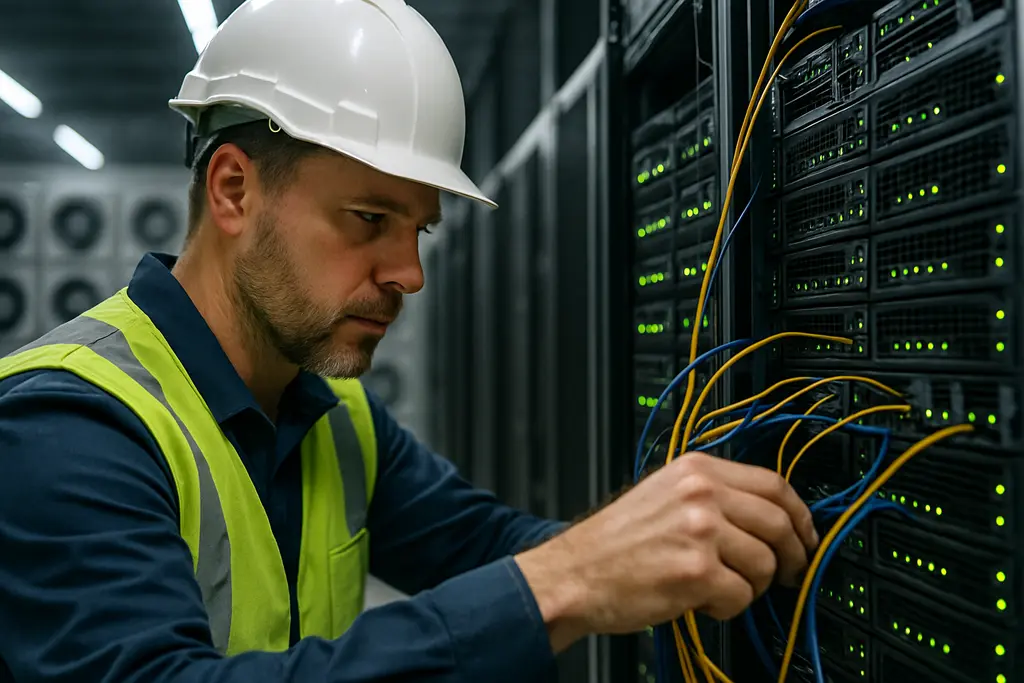
Data Center Costs now need to be read as an electricity, grid-capacity, and capital-allocation problem, not only as a server procurement issue. As of October 10, 2026, the clearest public data points show a sharp increase in energy use tied to data center growth and a specific pressure point from AI-oriented facilities. The evidence does not support simple claims that one technology choice can solve the issue. It supports a narrower finding: higher AI demand is raising the importance of power access, cooling capacity, and long-term infrastructure planning.
Data Center Costs And AI Load Growth
Data Center Costs In The 2025 Baseline
The International Energy Agency reported that data centre electricity consumption rose 17% in 2025, while AI-focused data centre consumption was growing faster and was expected to triple by 2030. The same IEA report said capital expenditure by five large technology firms exceeded USD 400 billion in 2025, with a 75% projected increase for 2026 IEA data centre report. These figures do not identify the cost profile of every project, but they show why power and construction planning have moved closer to the center of AI infrastructure decisions.
For classroom analysis, I treat these numbers as a useful boundary condition. A student does not need proprietary facility data to understand the direction of the problem. If total electricity use rises while AI-specific consumption rises faster, then operators face pressure on grid interconnection, backup capacity, cooling design, and site selection. That is why Data Center Costs should be modeled as a system-level question rather than a single line item.
Why AI Facilities Shift The Load Profile
AI-oriented data centers can differ from general-purpose enterprise sites because high-density compute clusters concentrate electrical load and heat output in fewer physical areas. The research notes do not provide per-rack power values, cooling system specifications, or utilization rates, so it would be unsafe to claim a universal facility design. The supported point is more limited: AI-focused facilities are associated with faster electricity-demand growth, and that growth affects the supporting infrastructure around the servers.
This distinction matters for procurement teams, utility planners, and local permitting bodies. Buying accelerators is only one part of deployment. The facility must also deliver power, remove heat, maintain uptime targets, and secure operations. In a hands-on lesson, learners can map these dependencies as a block diagram: grid connection, transformers, power distribution, compute hardware, cooling loop, monitoring systems, and maintenance staff. The exercise makes the cost chain visible without pretending that one generic design fits every site.
Power Demand And Grid Bottlenecks
From Terawatt-Hours To Gigawatts
In July 2026, Network World reported Gartner projections that global data center electricity consumption would grow 26% in 2026, rising from 447 TWh in 2025 to about 565 TWh. The same report described worldwide data center power demand of about 133 GW in 2026, compared with about 105 GW in 2025, with a projection of 291 GW by 2030 Gartner projection report. These numbers are forecasts for large aggregated systems, so they should not be treated as precise predictions for any single city, utility territory, or operator.
The distinction between TWh and GW is useful in technical education. Terawatt-hours describe energy consumed over time. Gigawatts describe power demand at a point or over a planning interval. A region can have enough annual energy generation but still struggle with local delivery capacity if substations, transmission lines, or interconnection queues cannot support concentrated loads. That is one reason electricity supply can become a schedule constraint even when compute hardware is ready to ship.
Facility Timelines And Local Effects
Rising load does not affect every community in the same way. The research notes point to fast growth, but they do not provide location-level grid maps, utility tariffs, or interconnection timelines. A cautious reading is that local conditions matter. A data center campus near available transmission capacity may face a different schedule and cost profile than a project requiring new grid infrastructure.
This is where planning intersects with procurement. Long-lead electrical gear, utility approvals, cooling equipment, and construction sequencing can all affect delivery dates. A related analysis of data center supply chain limits frames power access as one of several constraints that can delay capacity. That link between physical infrastructure and compute deployment is often clearer to students when they compare a small electronics bench supply with a facility-scale power system: both must deliver the required voltage, current, and safety margin, but the approval and build timelines are not comparable.
Capital Allocation, Cooling, And Operational Risk
What The Available Numbers Do Not Resolve
The public figures show demand growth, but they do not resolve the full cost stack. They do not specify the price of electricity contracts, the exact share of spending assigned to cooling, the cost of land, the efficiency of a specific building, or how many hours AI systems run at high utilization. Any claim that a particular cooling method or chip type will automatically reduce facility spending would need project-level evidence.
For operators, the safest interpretation is that power-related costs deserve early analysis. Electrical capacity affects site choice. Cooling capacity affects building design. Maintenance practices affect uptime and energy waste. Workload scheduling can affect load shape, though the research notes do not quantify how much scheduling reduces demand. These are configuration-dependent outcomes, and they should be tested with measured facility data rather than assumed from marketing materials.
Security And Resource Planning
A related site in the same network, bestantiviruspro.org, offers insights into endpoint protection topics, reminding us that while infrastructure risk and grid-capacity planning are separate issues, understanding multiple dimensions of risk is crucial. Resource planning should also stay separate from unrelated security claims. A facility can be efficient and still have weak access control, poor patch management, or inadequate monitoring. Conversely, strong cybersecurity does not solve power constraints.
For AI data centers, operational risk sits across several domains. Power loss, cooling failure, network interruption, and software misconfiguration can all affect service availability. The research provided here is strongest on electricity and capital pressure, not on cyber incidents or facility outage rates. That boundary matters. Evidence-based planning should not stretch energy data into claims about security performance unless separate security sources support it.
Classroom And Planning Uses For Evidence

A Practical Cost Model For Students
Data Center Costs can be converted into a practical classroom model without requiring proprietary budgets. The objective is not to simulate a real hyperscale project in full detail. It is to teach how demand, capacity, and constraints interact. Students can start with the reported 2025 and 2026 electricity figures, then identify which assumptions are known and which remain uncertain.
- Separate annual energy consumption from peak or planned power demand.
- Mark which values are historical reports and which values are projections.
- List the facility systems affected by higher electrical load, including power distribution and cooling.
- Identify missing variables before making any cost estimate, such as local tariffs or utilization.
This kind of exercise is useful for electronics education because it scales familiar concepts. A breadboard overheats if current exceeds component limits. A power supply must be sized for the load. A facility follows the same physics, even though the equipment, safety rules, and project management are far larger.
Questions For Operators And Communities
Operators and communities can use the same evidence to ask sharper questions. Is the project constrained by total energy, local delivery capacity, or equipment lead times? Are electricity projections based on measured load, contracted capacity, or expected future deployment? Does the project plan account for cooling energy and maintenance, or only server procurement? The research notes do not answer these questions for individual sites, but they show why the questions are necessary.
Local effects also need careful handling. Aggregate global growth does not prove that every electricity price increase comes from data centers. It does show that large new loads can become material for utilities and planners. A sound public discussion should separate measured local impacts from global projections and should avoid assigning costs without utility-territory evidence.
Data Center Costs Under AI Demand Pressure
What Can Be Said With Confidence
The supported conclusion is narrow but significant: electricity demand from data centers rose sharply in 2025, and 2026 projections pointed to further growth. AI-focused facilities were identified as a faster-growing part of that demand. Large technology firms also increased capital spending, which suggests that compute expansion was not limited to software decisions or chip purchases.
For planners, Data Center Costs are no longer well described by equipment price alone. They include power availability, grid timing, cooling design, construction scheduling, and operational controls. The evidence does not justify a single universal cost formula. It does justify a disciplined planning method: use dated figures, separate reported data from projections, document local assumptions, and test claims against measured facility performance whenever possible.