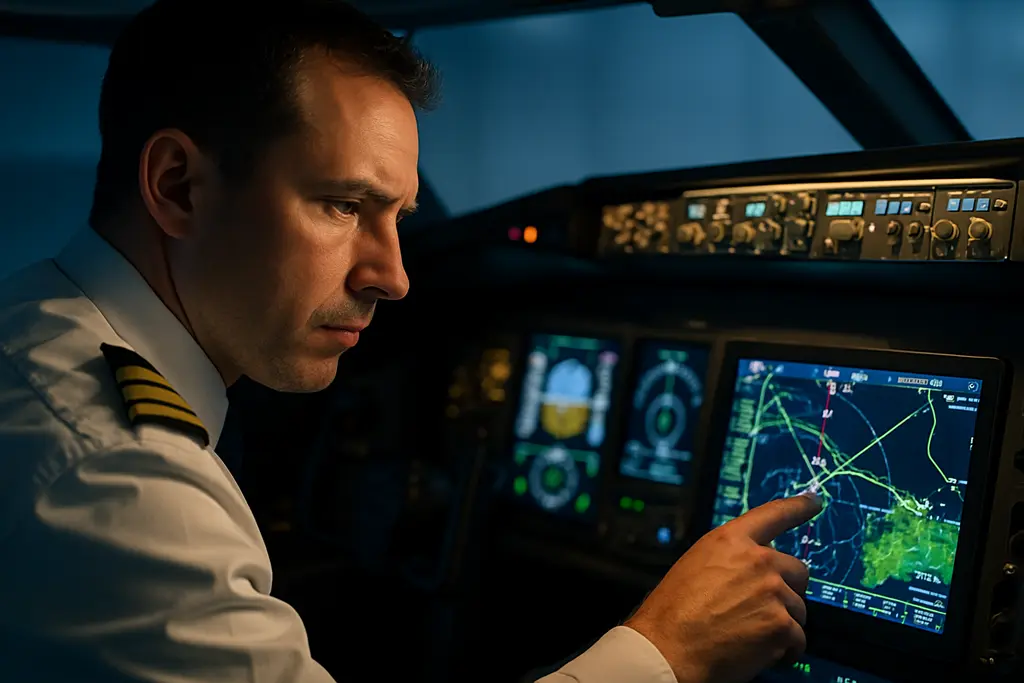
Predictive AI rerouting is a useful classroom topic because recent air traffic disruptions show both the value and the limits of prediction. The lesson should not present AI as an automatic fix for congestion, weather, or aging infrastructure. A better approach is to ask students to compare three evidence types: software failure reports, weather-delay data, and human decision requirements. That framing keeps the exercise technical, practical, and grounded in verifiable operational constraints.
Recent Disruptions As Engineering Evidence
On September 8, 2026, the UK air traffic control provider NATS suffered a system outage linked in the research notes to a millisecond-scale software defect in its flight data system. The described failure involved simultaneous requests pausing and resuming incorrectly, which corrupted outputs and led to reduced airspace capacity. The disruption affected flights above 24,500 feet over the London control region, yet restrictions were applied nationwide so the system could be reassessed safely.
The same incident affected hundreds of thousands of passengers, led to more than 2,000 flight cancellations, and caused delays that continued into later days. For a lesson plan, the most useful technical point is not only the scale of disruption. It is the fact that a small timing defect, described as a legacy and previously unknown race condition, was able to affect a much larger operational network. Students should treat that as a systems-engineering case, not as a generic technology failure.
Race Conditions And Operational Cascades
A race condition occurs when software behavior depends on timing between operations. In an air traffic context, the risk is not limited to one faulty calculation. If flight data, manual request handling, and automatic allocation processes interact at the wrong moment, downstream systems may receive inconsistent information. A safe response may then require reduced capacity even after engineers understand the likely defect, because controllers and operators need trusted system state before returning to regular flow.
This is a practical classroom entry point for teaching why safety-critical systems rely on redundancy, fallback procedures, and staged recovery. A model does not need to be maliciously attacked to create operational strain. The NATS example from September 8, 2026, as provided in the research set, was explicitly described as not being a cyberattack. That distinction matters because defensive planning for software defects differs from cyber incident response, even though both can require traffic restrictions.
What Predictive AI Rerouting Can And Cannot Infer
Weather is a central cause of flight delay, so it is a reasonable input for route-planning tools. The FAA states that more than 74 percent of U.S. air traffic system delays of 15 minutes or more from June 2017 through May 2023 were caused by weather, while equipment failure accounted for about 0.6 percent, according to the agency’s weather delay FAQ. That distribution supports a lesson focus on forecasting, uncertainty, and decision thresholds.
Research notes also describe a June 2026 academic study in which 58.7 percent of irregular flights globally in 2025 were attributed to thunderstorms. In that study’s modeling, rerouting based on real-time nowcasting reduced delay costs by 10 to 15 percent compared with static route planning. Those figures are useful for classroom analysis, but students should read them as model-based findings, not guaranteed savings in every airspace or airline operation.
Predictive AI Rerouting Data Exercise
A practical exercise can give students a simplified traffic grid with weather cells, scheduled departures, aircraft already airborne, and capacity limits at several sectors. The task is to compare static route planning with a forecast-informed reroute. A predictive AI rerouting tool can be represented by a spreadsheet model that assigns risk scores to sectors based on weather intensity, expected traffic load, and available capacity. Students then propose route changes and record tradeoffs in delay, sector overload, and controller workload.
The exercise should require students to state assumptions. For example, if the model predicts a storm cell will move east within two hours, students should identify what happens if the storm slows or intensifies. If a route avoids weather but pushes flights into a sector with reduced staffing or technical limits, students should flag the new constraint. This keeps the work closer to dispatch and flow-management practice than a simple shortest-path puzzle.
Classroom Model For Human-AI Handoff
On June 22, 2026, the FAA awarded Air Space Intelligence the Flow Management Data and Services contract and its AI-enhanced SMART component, according to the research notes. The described system centralizes 200 data streams, including weather, schedules, and capacity snapshots, to predict bottlenecks across different time horizons. A related site article on FAA SMART AI limits can help instructors keep the discussion focused on scope, training, and governance rather than broad claims about automation.
Students should map the handoff between machine outputs and human decisions. A prediction may identify probable congestion hours in advance, but it does not by itself authorize a reroute, reduce separation requirements, or decide how controllers manage a live sector. The model output needs context: aircraft performance, airspace restrictions, weather uncertainty, controller workload, airline operations, and passenger connections. Treating the tool as a decision aid rather than an autonomous authority gives the lesson a more accurate safety posture.
Verification Before Classroom Claims
The FAA’s National Aviation Research Plan 2025–2029, as summarized in the research notes, identifies AI and machine learning as emerging technologies while cautioning that safety-critical digital aviation systems raise verification, validation, and regulatory challenges. That is a strong prompt for student questions. What data was used to train or tune a prediction? How often is it updated? What happens when sensor feeds disagree? Who sees uncertainty bands, and how are they trained to interpret them?
The GAO reported in June 2024 that FAA modernization faced challenges tied to aging systems and the need for clearer action on air traffic control modernization, as described in GAO-24-107001. In lesson terms, this means predictive tools should not be taught as isolated software products. They sit on top of communications, surveillance, data management, staffing, maintenance, and governance systems. If those layers are inconsistent, prediction quality and operator trust can degrade.
Assessment And Failure-Mode Questions

Assessment should test reasoning, not memorization. Give students a scenario in which weather nowcasting improves one route but a legacy data service returns delayed capacity information. Ask whether the reroute should proceed, be held for human review, or be limited to lower-risk flights. The best answers should distinguish prediction confidence, operational authority, and safety assurance.
- Data quality: Which inputs are live, delayed, estimated, or manually entered?
- Failure containment: What happens if one data stream becomes inconsistent with the others?
- Human factors: Can a controller or dispatcher understand why the tool recommends a reroute?
- Recovery: How does the operation return to normal after capacity is reduced?
- Evidence limits: Which results come from operational data, and which come from modeling?
ITA Airways was described in the research notes as implementing an AI-driven dispatch tool called Maverick, with phased use aimed at improving situational awareness and speeding rerouting decisions around weather and congestion. The tool was scheduled to go fully live in Q1 2026. Since the supplied research does not provide a verified post-rollout result, a classroom case should treat full operational status and measured outcomes as unconfirmed rather than assuming final performance.
Scoring Evidence Instead Of Hype
A simple rubric can assign points for identifying constraints, using date-specific evidence, explaining uncertainty, and separating model recommendation from operational decision. Penalize answers that claim automatic safety gains without evidence. Reward answers that identify how a small software defect, such as the September 8, 2026 NATS race condition described in the research set, can force broad capacity reductions even when the initial problem appears narrow.
For cross-disciplinary teachers building media literacy or civic infrastructure discussions alongside aviation engineering, a related educational resource like Way Latino can provide valuable context. This helps broaden discussions without shifting the technical focus of air traffic lessons.
Predictive AI Rerouting Lesson Plan
A strong lesson sequence starts with the September 8, 2026 NATS outage as a software reliability case, moves to FAA weather-delay statistics, and then asks students to design a human-reviewed rerouting workflow. The final artifact can be a one-page operational memo. Students should describe the inputs their model uses, the failure modes they considered, the human approval step, and the evidence they would need before deployment.
The central lesson is that predictive AI rerouting depends on more than model accuracy. It depends on trusted data streams, aging infrastructure controls, transparent uncertainty, human training, and conservative recovery procedures. Recent disruptions make the teaching case stronger because they show how weather, software timing defects, and system modernization limits can interact in real operations. That is a more useful classroom outcome than asking students to believe that prediction alone can clear congested airspace.