
Physical parts burn out when you wire them backward. Replacing damaged microcontrollers costs money and halts your learning process immediately. Electronics educational computer games solve this physical limitation. You test your ideas safely on a digital screen before touching real wires. These programs let you drop components onto a virtual Continue Reading
Cory Ferguson
Getting Kids Interested in Electronic Projects
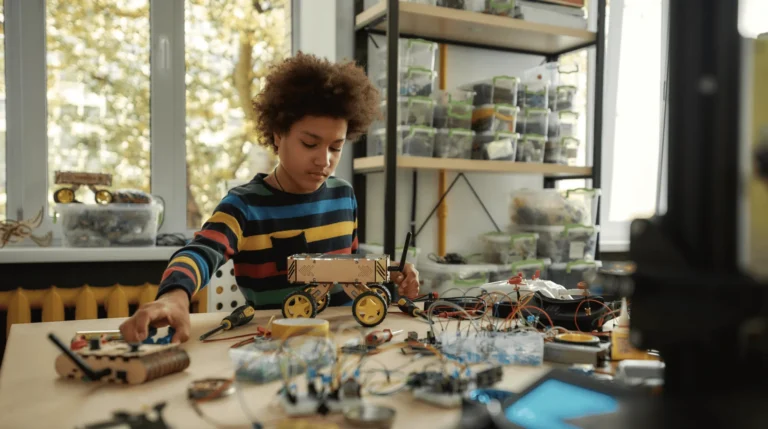
Children possess a natural curiosity about how the world operates. You capture that curiosity by skipping dry textbooks and handing them physical parts. Getting kids interested in electronic projects starts with immediate, visible results. A blinking light or a noisy buzzer provides instant feedback that keeps a young builder engaged. Continue Reading
How to Choose Your First Multimeter

Electricity is invisible. When a circuit fails, staring at the wires rarely reveals the actual problem. You need a way to measure the voltage and track the exact path of the current. Learning how to choose your first multimeter gives you the ability to diagnose hardware issues logically instead of Continue Reading
Practical Robotics Projects for Kids to Build at Home

Teaching hardware logic becomes much easier when the results physically move across the table. Blinking lights teach fundamental electrical rules, but robotics projects for kids turn abstract electrical loops into kinetic movement. You combine basic circuits with mechanical parts, forcing young builders to solve physical problems. They learn how to Continue Reading
Arduino Randomizer Project on a Breadboard

Computers love predictability. They excel at following exact instructions repeatedly without variation. Forcing a highly structured microchip to act unpredictably requires a specific hardware approach. When you build an Arduino randomizer project, you train your microcontroller to simulate chance. People use these circuits as digital dice for board games or Continue Reading
Starting an Electronics Club at School

Learning how circuits work often begins as a solo activity on a bedroom desk. Bringing that experience into a classroom changes the dynamic completely. Starting an electronics club at school creates a collaborative environment where students solve physical hardware problems together. You transition from following a single diagram alone to Continue Reading
Beginner Soldering Tips for Making Permanent Circuits

Moving from a breadboard to a printed circuit board changes how you build. You stop relying on friction to hold your wires in place and start melting metal to form permanent bonds. Applying a few beginner soldering tips prevents you from damaging your components or dealing with loose connections. Soldering Continue Reading
The Best Batteries for Simple Electronics Projects

Every circuit needs a safe, reliable energy source to function. Selecting the best batteries for simple electronics projects keeps your hardware safe and prevents frustrating voltage drops. Beginners often grab whatever battery they find in a drawer, expecting it to run any component they wire up. Matching the exact voltage Continue Reading
Testing Conductors vs Insulators on a Breadboard

When you build a circuit, you rely on jumper wires to move power from the battery to your components. The metal inside the wire allows the energy to pass, while the plastic outside blocks the energy from shocking your fingers. This basic relationship forms the foundation of all electronics. Testing Continue Reading
Build an Electronic Coin Flipper

Flipping a coin settles arguments and starts board games. Replacing a physical quarter with a flashing circuit brings that simple action to your desktop. You build an electronic coin flipper to practice digital logic and multiple outputs. You press a single button, and the board randomly lands on a green Continue Reading