
Teaching neural network energy as a straight line from model size to power draw is no longer technically adequate. Recent 2026 research indicates that energy use depends on interactions among hyperparameters, memory access, accelerator count, batch size, model shape, and workload target. For educators building classroom labs, and for engineers designing test plans, the main lesson is practical: counting parameters or FLOPs alone can hide the parts of a configuration that consume energy.
How Neural Network Energy Becomes Non-Linear
Neural Network Energy In Classroom Measurements
A useful classroom exercise is to ask students to train the same small network under several controlled settings, then compare accuracy, runtime, and measured energy. The finding they should expect is not a neat proportional curve. A 2026 empirical study known as BUTTER-E examined 41,129 training runs across 30,582 distinct fully connected-network configurations. It found that, even on the same model and hardware, suboptimal hyperparameter setups could consume up to five times more energy than better-tuned setups to reach the same accuracy, according to the BUTTER-E analysis.
That result is valuable for hands-on instruction because it separates two ideas that are often blurred. A smaller model can be cheaper to store and may require fewer arithmetic operations, but those facts do not automatically mean lower energy to train. The research notes that memory hierarchy, network shape, and batch size can create hardware-mediated effects. In practical terms, a narrower or shallower configuration may reduce one cost while increasing another, such as memory movement or inefficient accelerator use.
Why Parameter Count Is An Incomplete Proxy
Parameter count is easy to calculate, so it is tempting to treat it as a classroom or engineering shortcut. The evidence does not support using it as a full substitute for measurement. FLOPs also have limits as a proxy because two configurations with similar arithmetic counts can move data through memory in different patterns. If a configuration triggers less efficient memory access or lower hardware utilization, its measured energy may exceed expectations based on compute counts alone.
This is where neural network energy differs from many introductory electronics examples. With a resistor and a fixed supply voltage, the expected power relation is direct enough for a first lab. Neural network training is a system-level workload. The software schedule, data movement, precision mode, and hardware occupancy all affect the final reading. Students should still learn simple equations, but they also need experiments that show where those equations stop describing the whole system.
Batch Size, Memory, And Accelerator Count
Batch Size Changes More Than Runtime
Batch size is a clear example of a configuration variable with mixed effects. Research summarized in the provided notes reports that increasing batch size can reduce wall-clock time while raising instantaneous power demand. One high-resolution AI data center workload study found that increasing batch size from 128 to 512 raised node-GPU peak power from about 4.5 kW to 6.6 kW, while epoch time dropped by roughly 30 to 35 percent. That combination does not answer the energy question by itself. A shorter run at higher power may save energy, cost the same, or use more energy, depending on the exact duration and power curve.
Other 2026 work on parallel neural network training reported that energy consumption scales approximately linearly with GPU-hours, but the scaling factor changes with global batch size, local batch size, number of gradient updates, model type, and hardware type. The same notes also report that, for ResNet50 on ImageNet, very large global batch sizes reached a point where accuracy returns diminished while energy continued to rise. This is a useful warning for lab design: students should not optimize for runtime alone if the assignment is about energy-aware training.
Memory-Bound And Compute-Bound Behavior
The research notes also distinguish memory-dominated and compute-dominated behavior. A comparative study on weight-memory energy versus computing energy reported that ResNet18 can shift from memory-energy dominated at small batch sizes to compute-energy dominated at larger ones. Transformer-style models, including GPT-like models referenced in the notes, were described as remaining predominantly memory-bound across batch sizes because large parameter tensors and frequent key/value caching dominate the energy cost.
For educators, this gives a strong reason to compare model families rather than presenting all neural networks as one category. A convolutional model and a transformer-style model can respond differently to the same batch-size change. An electronics kit analogy is a motor driver versus an LED strip: both are loads, but they stress the supply in different ways. The same type of distinction applies here, except the stress appears in memory bandwidth, accelerator occupancy, and data transfer patterns.
Measurement Design For Teaching And Engineering
Controls That Make Comparisons Fair
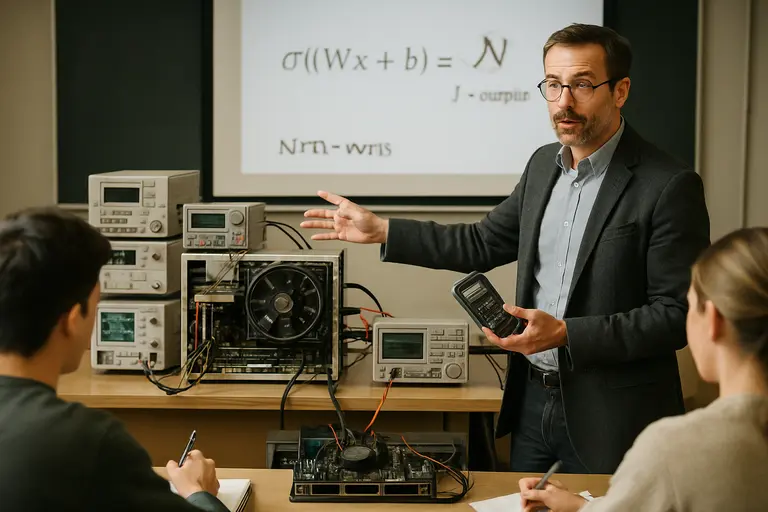
A practical neural network energy lab needs strict controls. The model, dataset, hardware, driver settings, precision mode, and stopping condition should be recorded before comparing runs. If the stopping condition is fixed epoch count, a low-accuracy configuration may appear cheaper while producing a weak result. If the stopping condition is target accuracy, the experiment better reflects the BUTTER-E finding that poor hyperparameters can waste energy before reaching the same goal.
The measurement plan should also define whether the class is measuring instantaneous power, energy per epoch, energy to target accuracy, or energy per sample. These are not interchangeable. Peak power matters for facility planning and thermal design. Total energy matters for operating cost and grid demand. Energy per useful output matters when comparing inference systems or training recipes. A single number can be useful only after its boundary is defined.
Security And Maintenance Boundaries
Energy experiments also need ordinary system hygiene. Shared lab machines should use known software images, documented package versions, and access controls that prevent accidental changes between student groups. For readers who are interested in network security and system protection, this site network also includes antivirus software coverage. That link is not a substitute for a lab security policy, but it fits the broader point: uncontrolled system state can make technical measurements less trustworthy.
Maintenance affects results because background processes, thermal throttling, and driver changes can alter a run without changing the model code. In a teaching lab, the best practice is to repeat a small number of runs and require students to report configuration details, not just final charts. In engineering work, the same principle applies at larger scale. A benchmark result without workload boundaries and system settings is hard to interpret.
Practical Limits Of Neural Network Energy Analysis
What MLPerf Power Shows About Scale
Large systems add another layer of non-linearity. The MLPerf Power paper, published on June 4, 2026, reported results across 1,841 submissions from 60 systems and found that energy scales non-linearly with accelerator count. Adding accelerators can produce diminishing returns because communication, memory bandwidth, and power inefficiencies grow, as described in MLPerf Power. This is not a claim that scaling is ineffective. It is evidence that scaling must be measured as a system behavior rather than inferred from device count.
The same research notes state that low-precision inference techniques, including quantization, can reduce energy cost per sample or token while maintaining accuracy in the studied submissions. The notes also caution that mixture-of-experts and sparsity techniques can introduce memory-bandwidth penalties that offset some compute gains. That distinction matters for procurement and curriculum: a method that reduces arithmetic may still move data in a costly pattern.
How To Teach The Limits Without Overclaiming
A responsible lesson on neural network energy should avoid declaring one architecture, accelerator count, or batch size universally best. The supported conclusion is narrower and more useful: energy is configuration-dependent, and the dependency is often non-linear. Students can test this by running a small grid of batch sizes or hidden-layer widths, then plotting energy to target accuracy rather than only runtime.
There are limits to what the cited evidence can settle. The research notes cover specific models, hardware types, datasets, precision settings, and benchmark submissions. Results from fully connected networks do not automatically transfer to every transformer workload. Results from one data center system do not fully predict a classroom workstation. Still, the consistent pattern across the notes is clear enough for technical planning: neural network energy should be measured under the actual configuration whenever the result will inform cost, capacity, or instructional claims.
For hands-on project kits and lesson plans, the best activity is not a single demonstration. It is a controlled comparison that lets learners see the trade-off directly: batch size may shorten training but raise peak power; fewer parameters may not reduce memory movement; more accelerators may lower time while adding communication overhead. That kind of lab teaches energy literacy without hype and gives students a more accurate model of how AI workloads behave on real hardware.