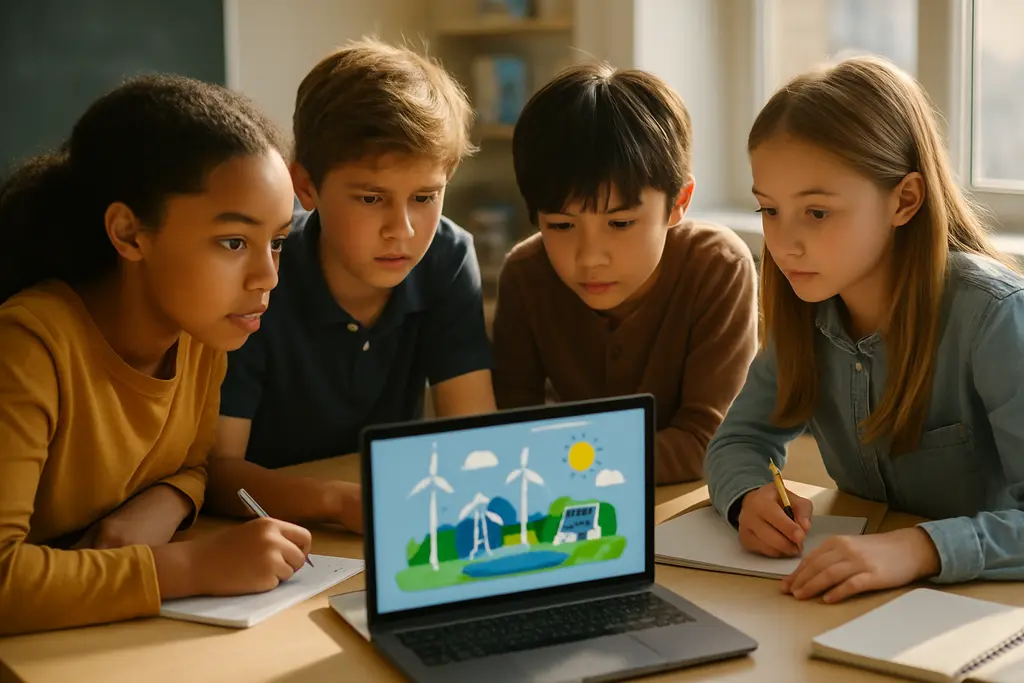
An AI Energy Lesson built around the September 29, 2026 CLEER technical report gives students a way to compare AI use cases with evidence rather than slogans. The lesson should separate three questions: how much accelerator energy a model may use for a task, how usage mode changes demand, and how data center electricity trends affect grid planning. CLEER is useful because it focuses on closed-model energy estimation, but students also need to understand its limits before treating any single number as a full energy accounting.
AI Energy Lesson Goals From CLEER
Framing The AI Energy Lesson Question
The central classroom question is narrow: how should a user or organization choose an AI system when task quality, cost, and energy are all part of the decision? The AI Energy Lesson starts with the CLEER report because it was released on September 29, 2026 and presented the Closed-model Latent Energy Estimation Range method. The report estimated accelerator energy consumption per output unit for closed AI models, using more than 2,400 test runs, more than 20 open models, and more than 425 million tokens as part of its evidence base, according to the CLEER technical report.
What Students Should Not Infer
Students should not read CLEER as a complete measure of all electricity used by a data center. The research notes describe accelerator energy consumption per output unit, not total facility power, cooling energy, network equipment, storage, or manufacturing impacts. That distinction matters in a classroom because a technically accurate claim may still be too narrow for a policy argument. A model that looks efficient under one task and output length may not remain efficient under a longer reasoning workflow or an agentic workflow.
CLEER Evidence Students Can Test
Model Choice And Task Type
CLEER reported that, for the same task, different AI models can vary in energy use by more than 30 times. It also reported that lower-cost models were not always more energy-efficient; in roughly one in five comparisons, the cheaper model used more energy. These findings are useful for a worksheet because they prevent a simple rule such as “small price means low energy.” Students can build a comparison matrix with columns for task, expected answer length, model tier, cost, and estimated energy range.
Agentic Sessions Versus Standard Chat
A useful AI Energy Lesson should include the difference between a standard chat session and an agentic session. CLEER reported that a typical agentic session used about 27 times more energy than a standard chat session, while a heavy agentic session could exceed 100 times the energy use for the same model. CLEER also reported that higher-capability tiers, such as Opus, Pro, or Sol examples in the research notes, consumed nearly four times the average energy of lightweight or faster tiers, such as Haiku, Flash, or Terra examples. In class, those ratios can be used without naming a winner, since the right choice depends on task needs and acceptable error.
- Ask students to define the task before selecting a model or mode.
- Have them compare a short-answer chat workflow with an agentic workflow that may require repeated tool use or planning steps.
- Require a short written caveat explaining which energy factors are outside the CLEER estimate.
Data Center Context For U.S. Grid Discussion
Connecting Per-Task Estimates To Grid Scale
Per-task estimates become more meaningful when students connect them to larger electricity demand. The U.S. data center electricity use projection in the 2025 update from Lawrence Berkeley National Laboratory estimated 649 terawatt-hours in 2030, with a scenario range of 521 to 843 terawatt-hours. The same research note states that this central estimate equals 11.8 percent of total U.S. electricity usage in 2030, depending on assumptions such as server lifetime, idle power, and equipment utilization, as reported in the U.S. data center energy update.
Why Scenario Assumptions Belong In The Lesson
In an AI Energy Lesson, the LBNL range is as valuable as the central projection. A single value can make students think the future is already fixed. A range shows that equipment utilization, idle power, hardware replacement cycles, and deployment patterns can shift the result. This also gives students a practical way to critique claims. If a slide or news item gives only one number, students can ask what scenario produced it and which assumptions were excluded.
For a thorough exploration of grid evidence and recent U.S. findings, teachers might consider supplementing this lesson plan with AI energy use in the U.S.. If educational materials are shared across related educational sites, WayLatino serves as a related site within the same network; ensure consistency of reused classroom text with the cited energy sources.
Assessment And Classroom Constraints

Evidence Checks Before Debate
The assessment should reward source handling, not just confident answers. Students can be asked to identify whether a claim refers to accelerator energy, whole-facility electricity, or national electricity demand. They can also label whether a number is measured, estimated, projected, or scenario-dependent. This keeps the activity grounded in technical reading instead of broad claims about whether AI is inherently good or harmful.
A Practical Scoring Rubric
A four-part rubric works well for this topic. First, students define the task and usage mode. Second, they apply the CLEER findings about model variation, cost not always matching energy efficiency, and higher energy use for agentic sessions. Third, they connect the classroom example to the U.S. data center projection without pretending that one prompt directly determines national demand. Fourth, they state at least two limitations, such as missing cooling energy, uncertain utilization, or task-dependent output length.
| Student Product | Evidence Requirement | Common Error To Flag |
|---|---|---|
| Model comparison note | Uses same task across models or tiers | Comparing unlike tasks |
| Agentic workflow sketch | Distinguishes standard chat from agentic use | Treating all prompts as equal |
| Grid context paragraph | Uses a projection with its stated range | Quoting only the central value |
AI Energy Lesson With CLEER Evidence
Classroom Takeaway For Technical Literacy
The strongest outcome is not a fixed rule about which model students should use. It is a habit of asking better engineering questions. What is the task? How long is the output? Is the workflow a single response or an agentic sequence? Does the evidence refer to accelerator energy only, or does it include a full data center boundary? Those questions keep the AI Energy Lesson accurate and useful for students who will see energy claims in product pages, policy debates, and school technology decisions.
For a defensible AI Energy Lesson, keep the claims modest: CLEER offered new evidence on energy differences across models and usage modes, while U.S. data center projections showed why scenario assumptions matter at grid scale. That combination gives students enough data to reason carefully without treating early estimation methods as final answers.