
AI energy demand has become a practical engineering issue, not only a policy topic. In 2024, global data centers consumed about 415 terawatt-hours of electricity, or roughly 1.5% of global electricity demand, according to the IEA’s energy demand analysis. The same analysis projected that all data center electricity use could reach about 945 TWh by 2030 in its Base Case, close to double the 2024 level. Those figures do not prove that every AI application is power-intensive, but they show why model design, hardware selection, and workload scheduling now matter in classrooms, labs, and production systems.
Why AI Energy Demand Is Rising
The technical shift is centered on computation density. AI workloads often run on accelerated servers built around specialized processors for matrix operations and parallel computation. These systems can process training and inference workloads faster than conventional servers, but they also concentrate electrical demand in racks that require power delivery, cooling, and facility support. The research notes indicate that accelerated server electricity consumption is projected to grow by about 30% annually in the base case through 2030, while conventional server electricity demand grows more slowly at around 9% per year.
This change affects more than the chip. High-density AI servers need supporting infrastructure: power conversion, network fabric, storage, backup systems, and thermal management. For makers and educators, the small-scale analogy is familiar. A microcontroller board may sip power, but adding motors, radios, displays, or a vision module changes the whole energy budget. At data center scale, the same principle becomes a planning constraint.
Accelerated Servers Change The Load Profile
Traditional web applications often produce many small, short transactions. AI models can produce a different load profile because inference may require many layers of computation for each prompt, and training can run large clusters for extended periods. The research notes also report that electricity consumed by AI-focused data centers grew by 50% in 2025, compared with 17% growth for data centers as a whole. That contrast suggests the increase is not only due to general internet growth; it is tied to the technical structure of AI workloads.
AI Energy Demand At The Query Level
Per-query numbers should be handled with care because model size, hardware, utilization, cooling, and output length all matter. The research notes cite an estimate of about 0.31 watt-hours per query for median inference energy in large deployments of frontier-scale models, with an interquartile range of 0.16 to 0.60 Wh. That is far lower than many rough public estimates. Yet the same notes report that reasoning queries, agentic workflows, or test-time scaling that produces thousands of output tokens can raise per-query energy by about 13 times, to around 3.9 Wh. A small number of heavier tasks can change the daily total.
Efficiency Gains Do Not Automatically Cut Total Use
Engineering teams often improve energy efficiency by using better chips, batching requests, reducing precision where acceptable, shortening outputs, and selecting smaller models for simpler tasks. These improvements matter. They can lower the energy needed for a single query or job. The difficult part is that lower per-task energy does not necessarily reduce total electricity use if the number of tasks rises quickly or if applications shift toward heavier workflows.
This is a basic rebound problem in technical systems. A more efficient device may become cheaper or easier to use, which can increase total usage. The research notes do not prove a single rebound rate for AI, and it would be risky to claim one. They do show that per-query inference can fall while total facility electricity rises. That means AI energy demand must be evaluated at both the workload and infrastructure level.
Per-Query Improvements And Heavy Tasks
The research notes mention that prompt choices and model selection can reduce energy use, including cases where replacing reasoning models with non-reasoning models for suitable tasks reduced energy use by up to 65%. The key engineering point is not that reasoning models are bad. It is that a reasoning model is not always the correct tool. A classification task, short rewrite, or simple lookup may not need a model configuration that spends many extra compute cycles generating intermediate reasoning or long output.
For education, this is a useful measurement exercise. Students can compare a short answer, a long answer, and a multi-step agent-style task by logging token counts, latency, and estimated energy. The estimate will be imperfect unless students have direct power telemetry, but the exercise teaches that software choices have electrical consequences. A related classroom treatment is available in this AI energy lesson, which connects model choice with data center electricity projections.
Classroom Measurement Limits
Small hardware projects make power visible. A USB power meter can show how a single-board computer behaves under idle, CPU load, and accelerator load. That does not translate directly to a hyperscale data center, but it does teach the measurement chain: device power, duty cycle, cooling overhead, and total energy over time. A related hardware site, HW Server, offers valuable insights for comparing component-level power and thermal limits in server-oriented systems.
The caution is that public AI energy figures are often estimates. Without direct disclosure of utilization, facility efficiency, hardware type, model configuration, and request mix, a single per-query number can mislead. The most defensible approach is to present ranges and explain what changes the result.
Grid And Cost Pressures From Data Centers
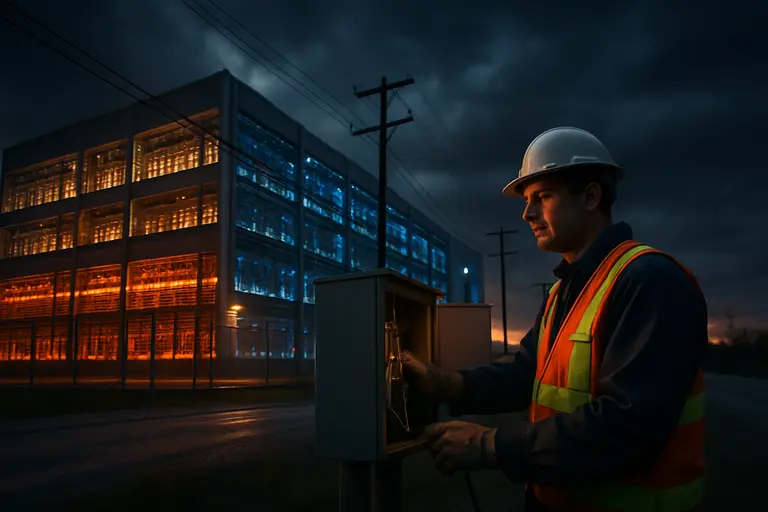
Data centers are large electrical customers. When AI workloads increase rack density and total utilization, utilities and operators must plan for interconnection capacity, substations, backup power, and cooling water or air-side cooling depending on the site. The research notes indicate that AI-producing sectors in the United States grew nearly three times faster than the broader private non-farm business sector, while electricity costs for vertically integrated AI companies nearly doubled between 2019 and 2023. Those numbers point to cost pressure, but they do not identify a single cause for every facility or region.
Location matters. A data center connected to a constrained grid faces different tradeoffs than one near underused generation or strong transmission. The same model workload can have different carbon and cost implications depending on the electricity mix and local peak demand. For technical teams, the practical question is not only how efficient the model is, but when and where the job runs.
Data Center Growth As Infrastructure
The IEA projection of about 945 TWh for global data center electricity use by 2030 in its Base Case is a system-level number. It includes more than AI, but the growth of accelerated servers helps explain why AI infrastructure receives close attention. Six leading AI data center firms were reported in the research notes to have used about 118 TWh in 2024, with projections of 239 to 295 TWh by 2030 depending on growth scenarios. Because these projections depend on deployment patterns, they should be treated as scenario-based planning inputs, not fixed outcomes.
What Operators Can Measure
Operators can make the discussion more concrete by tracking energy per training run, energy per thousand inference requests, average and peak power, accelerator utilization, cooling energy, and model output length. These measurements do not remove uncertainty, but they give teams a way to compare configurations. A smaller model that answers correctly with shorter latency and lower energy is often a better engineering fit than a larger model used by default.
AI Energy Demand In Model Design
Long-range projections carry wider uncertainty. One scenario-based study projected that AI’s share of global electricity use may reach between 13% and 47% by 2050, depending on deployment patterns, hardware efficiency, the balance between inference and training, and how electricity is produced, as reported in a scenario-based study. That range is broad, which is exactly why precise claims about distant energy outcomes should be avoided.
Near-term design decisions are clearer. Developers can route simple tasks to smaller models, avoid unnecessary long outputs, cache repeated answers where appropriate, batch work when latency allows, and measure energy against accuracy rather than treating model size as the default quality signal. These are ordinary engineering controls, not magic fixes. They reduce waste only when matched to real workloads.
Design Choices That Reduce Waste
AI energy demand should be taught as a systems problem. The model, prompt, hardware, cooling system, and grid connection all influence the final electricity total. A cautious technical review asks what changed, what was measured, what was estimated, and which configuration produced the result. That framing helps students and builders avoid both hype and dismissal. AI can be useful, but its energy cost is not abstract; it is a measurable part of system design.