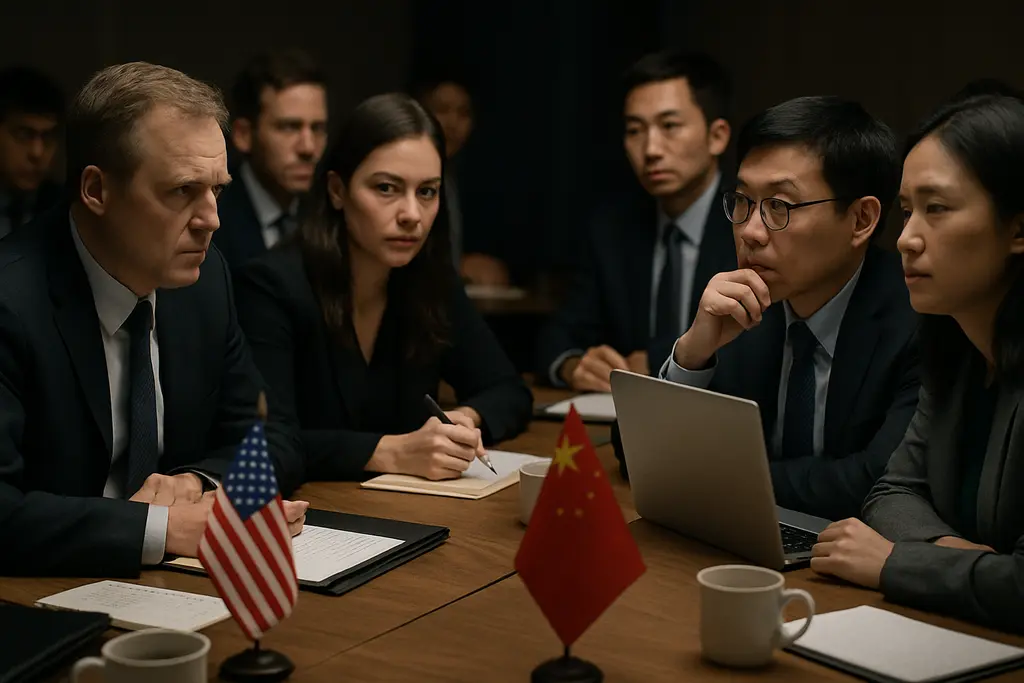
AI governance standards are no longer only a technical drafting problem. They are being shaped by diplomatic channels, national security claims, trade discussions, and disputes over how advanced AI systems are built or copied. For educators and engineers, the lesson is similar to teaching a classroom robotics build: a working system needs clear inputs, agreed signals, predictable failure modes, and a procedure for what happens when something goes wrong.
Why AI Governance Standards Shifted After The Summit
AI Governance Standards And Incident Channels
On September 25, 2026, during a three-day summit in Washington, U.S. President Donald Trump and China’s Xi Jinping agreed to establish an “AI safety channel” for AI-related incidents and to accelerate military crisis communication, according to The Washington Post. The same report said the two governments confirmed the operation of a Board of Trade to address bilateral trade issues. Those facts matter because AI safety, military communication, and trade were treated as connected policy areas rather than separate tracks.
For AI governance standards, the main change is procedural. A safety channel does not by itself define a benchmark, a model-testing method, or an audit protocol. It creates a path for incident reporting between governments. That may help reduce confusion after an AI-related event, but it leaves many technical questions open: who classifies an event, what evidence must be preserved, what counts as a model-related incident, and how quickly each side must respond.
From Diplomacy To Technical Process
In a classroom electronics lab, a loose ground wire can make a circuit behave unpredictably. The fix is not only to tell students to “be careful”; it is to specify the wiring, test the voltage, and document the result. International AI governance has a similar need for defined steps. If an incident involves a frontier model, a deployed chatbot, a robotics platform, or a cyber-defense tool, a vague warning is not enough. The parties need shared categories and a record that can be checked after the fact.
This is where U.S.-China relations affect standardization directly. If diplomatic trust is limited, technical standards must carry more of the burden. Standards bodies and regulators may need terminology that works even when governments disagree about motive. A standard can define the structure of a report, the timestamp format, or the minimum incident description. It cannot force political trust.
What The Safety Channel Can And Cannot Standardize
Useful Scope For A Safety Channel
A realistic safety channel can support a narrow set of functions. It can identify points of contact, create a routine for escalating AI-related incidents, and reduce delays during a crisis. It can also separate urgent technical notice from slower political negotiation. These are practical functions, especially when AI systems are connected to military planning, public information, infrastructure management, or commercial platforms.
The channel’s value depends on operational detail. A workable process would need a shared incident vocabulary, a format for technical attachments, and rules for handling sensitive information. It would also need a way to distinguish confirmed facts from early observations. That distinction is central in STEM teaching as well: a student’s first hypothesis about why a motor failed is not the same as a measured current draw or a verified wiring fault.
Limits Of Agreement Without Verification
The limits are just as significant. An AI safety channel does not automatically create inspection rights, source-code access, model-weight access, or a shared audit laboratory. It does not settle export policy. It does not resolve claims that one side is using another side’s systems to gain technical advantage. For AI governance standards to become more than diplomatic language, procedures must be specific enough to be tested.
That is why earlier technical proposals remain relevant. A related analysis of the AI safety alert proposal examined the problem of thresholds and verification gaps. The same concern applies here. If a channel has no agreed trigger, one country may treat an event as serious while the other treats it as routine platform behavior.
Model Distillation Claims And Verification Problems
Why Distillation Disputes Are Hard To Prove
Before the September 2026 summit, China rejected U.S. claims that Chinese AI firms, including DeepSeek, Alibaba, Moonshot AI, and Z.ai, had engaged in “malicious” extraction of U.S. model capabilities, according to AP News. The dispute shows why standardization around model provenance is difficult. The accusation concerns how capabilities may have been obtained, not just whether two systems produce similar answers.
Model distillation can refer to extracting behavior from one model into another system. In governance terms, the challenge is evidentiary. Similar output does not automatically prove unauthorized extraction. At the same time, access logs, training data records, prompt histories, and contractual limits may be sensitive or unavailable. A standard that ignores these limits would be weak in practice.
Evidence Requirements Need Clear Boundaries
Any useful approach should separate three issues: technical similarity, access behavior, and policy violation. Technical similarity may be tested with prompts or task suites, but results can depend on configuration, sampling settings, and evaluation design. Access behavior requires records from systems that may be proprietary. Policy violation depends on the terms that governed use of the model or service.
This is a place where AI governance standards need modest claims. A standard can define what records should be kept, how long incident evidence should be retained, and how evaluators describe uncertainty. It cannot make every allegation publicly provable. The better goal is repeatable procedure: if an accusation is made, both sides know what evidence category is being discussed.
Effects On Companies, Schools, And Standards Bodies

Compliance Pressure For Builders And Vendors
Companies building AI systems may face more pressure to document model lineage, user access, safety testing, and incident response. The September 2026 summit did not publish a full technical standard in the cited reporting, so organizations should avoid assuming that a diplomatic channel equals a compliance checklist. The safer reading is narrower: governments are creating communication structures while leaving many engineering details unsettled.
For schools, libraries, and youth STEM programs, the impact is indirect but real. Students may encounter AI tools inside coding lessons, robotics projects, or research assignments. Educators do not need to teach diplomatic policy as a legal brief. They can teach the engineering habit behind good governance: define the system boundary, record the version used, describe observed behavior, and keep safety procedures separate from marketing claims. Teachers preparing slides for these lessons can access helpful educational materials from the site Free Slideshows, ensuring that their policy discussions are grounded in documented evidence.
Practical Questions For Standards Groups
Standards organizations and technical working groups will likely have to deal with questions that diplomacy leaves unresolved. The most useful work would be narrow and testable:
- How should an AI-related incident report identify the model, deployment context, and observed failure?
- Which evidence fields should be required, optional, or withheld for security reasons?
- How should uncertainty be labeled when model behavior cannot be reproduced exactly?
- What minimum audit trail should exist for high-risk model access?
- How should safety communications avoid exposing sensitive security details?
These questions are not abstract. If an AI system contributes to a false alert, an unsafe robotic action, or a harmful information release, responders need shared records. Without a shared format, each party may spend the first hours arguing over basic definitions rather than assessing risk.
U.S.-China Relations And AI Governance Standards
What Has Changed Since September 25, 2026
The main development after September 25, 2026, was not a finished global rulebook. It was the creation of a channel that could become part of the evidence and escalation system around serious AI incidents. That is a limited but meaningful shift. It acknowledges that AI-related events may require direct government communication, especially when trade tension, military signaling, and technology controls overlap.
AI governance standards will remain constrained by the same facts that shaped the summit: cooperation exists alongside accusation and strategic competition. The U.S. and China agreed to talk through a safety channel, but public disagreement over model distillation claims remained part of the policy setting. That combination suggests a practical path for standardization: focus first on incident definitions, reporting formats, evidence preservation, and escalation timing.
A Cautious Technical Reading
The most defensible reading is neither optimistic nor alarmist. A bilateral safety channel can reduce ambiguity during AI-related incidents, but it does not replace technical audits, export policy, domestic regulation, or independent standards work. It may support those systems if its procedures become specific enough to use under stress.
For engineers, educators, and policy teams, the lesson is concrete. AI governance standards should be written so that a disputed event can still be documented in a shared structure. That means defining terms before a crisis, separating measurements from accusations, and accepting that some evidence will remain restricted. Good classroom engineering follows the same rule: the system is easier to debug when the signals, limits, and records are clear before the failure occurs.