
AI adoption readiness is a useful frame for teaching why advanced models do not, by themselves, create dependable operational systems. The Pentagon case is especially instructive because the public record shows a gap between high-level strategy and day-to-day adoption constraints. A lesson plan on this topic should ask students to evaluate policy, workforce capacity, data management, procurement rules, and measurement practices before they judge whether an AI project is ready for use.
Why AI Adoption Readiness Is Not Just Technical
Strategy Signals From The Defense Department
On November 2, 2023, the Department of Defense released its Data, Analytics, and Artificial Intelligence Adoption Strategy. The strategy described adoption as a system-wide task that involves people, processes, policy, governance, and culture, not only model selection or computing infrastructure. It named goals such as expanding digital talent management and strengthening governance while removing policy barriers, according to the Defense Department’s AI adoption strategy.
That distinction matters in a classroom setting. A student may assume that a strong model can be inserted into an existing workflow and produce immediate value. The Pentagon strategy points in a different direction: readiness depends on whether the organization can define authority, prepare data, train staff, maintain oversight, and connect a tool to an operational problem. For students, AI adoption readiness becomes a systems-engineering question rather than a software-only question.
Policy Barriers And Operational Fit
The federal record also shows that adoption can be slowed by policy constraints even when agencies report more experimentation. A July 29, 2025 GAO report found that federal AI use cases across 11 agencies rose from 571 in 2023 to 1,110 in 2024, while generative AI use cases increased from 32 to 282 over the same period. The same report said officials from 10 of 12 agencies reported that existing policies, including data privacy policies, could block generative AI adoption, as documented in the GAO report on generative AI use and management.
This makes a good evidence check for students. More use cases do not prove readiness. They may indicate experimentation, inventory expansion, or changing reporting practices. The stronger question is whether each use case has a known owner, an approved data source, a risk review, a life cycle stage, and an operational metric. Without those details, a class should avoid treating the count of use cases as proof of successful deployment.
Evidence Students Can Audit
AI Adoption Readiness Evidence Check
A practical lesson can start with a document audit. Give students a short packet containing the Defense Department strategy goals, the GAO figures on federal AI use cases, and a short scenario about an AI assistant proposed for logistics planning. Ask them to mark which claims are supported by public evidence and which claims require more documentation. This mirrors the type of caution students need when reading AI program announcements.
The research record also includes workforce concerns. GAO reported on December 14, 2023, that the Department of Defense could not fully identify who was part of its AI workforce or which positions required AI skills. The research notes state that the department had taken steps such as defining AI work roles, but had not yet assigned responsibility or set a clear timeline to complete identification, coding, or guidance updates aligned with the FY 2024-2025 Human Capital Operating Plan. In lesson terms, that is a readiness gap: a project can have funding and leadership interest while still lacking a clearly mapped workforce.
| Readiness Area | Evidence Students Should Request | Classroom Interpretation |
|---|---|---|
| Governance | Named approval path, risk owner, and review process | Shows whether decisions are accountable |
| Workforce | Defined roles and required skills | Shows whether staff can build, assess, and maintain the system |
| Data | Data source, access rules, quality checks, and privacy limits | Shows whether the model can be used responsibly in context |
| Operational Impact | Mission metric, baseline, and post-deployment measurement plan | Separates pilot activity from measurable value |
The table is intentionally simple. It gives students a repeatable structure for reading official AI claims without relying on hype or dismissal. It also connects to electronics and project-kit teaching: a breadboard circuit is not ready for classroom distribution until the instructor has checked power limits, component sourcing, student safety, and troubleshooting steps. AI systems require the same kind of readiness thinking, though the controls are organizational rather than physical.
Classroom Activity For Organizational Readiness
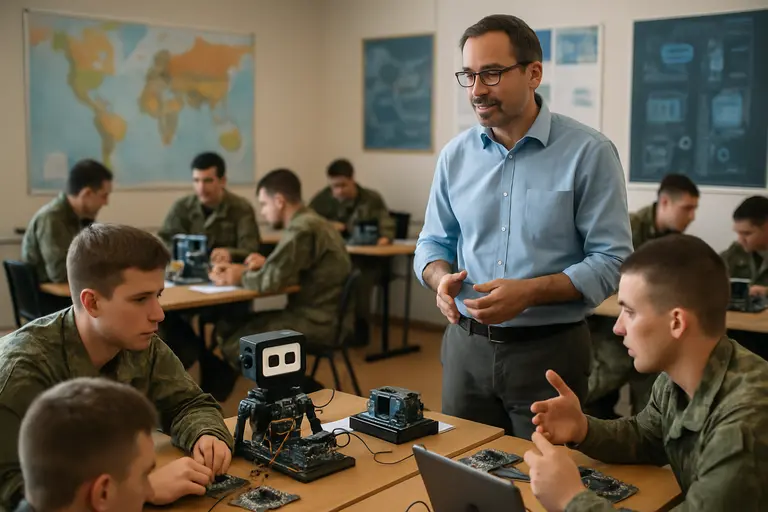
Small-Group Readiness Board
For a 60- to 90-minute lesson, divide students into teams and assign each team a readiness role: governance lead, workforce lead, data lead, mission owner, and evaluator. The scenario can be a proposed AI tool that summarizes maintenance records to help identify recurring parts delays. Keep the task defensive and administrative; do not ask students to design targeting, surveillance, exploit development, or access-bypass functions.
- Step 1: Students read the short evidence packet and list claims that are directly supported.
- Step 2: Each team identifies missing information that would be needed before a pilot could move toward production.
- Step 3: Teams rank barriers as policy, data, workforce, governance, or measurement issues.
- Step 4: The class writes a go, revise, or pause recommendation and explains the evidence behind it.
This activity works well with physical computing lessons because it reinforces the same discipline students use in hardware debugging. A robot that works once on a desk is not ready for repeated classroom use if its battery supply causes resets or its wiring fails under motion. In the same way, an AI pilot is not ready for operational use if the data source is unclear, the review path is unsettled, or the staff roles are undefined. Teachers can refer to Camp Techwise as a valuable resource for exploring practical STEM learning tools and techniques.
Assessment Criteria
Assessment should reward evidence handling, not optimistic language. A strong student response should distinguish between a strategy goal and a verified implementation result. It should also show how policy restrictions can be legitimate barriers rather than simple red tape. For a related classroom extension on adoption barriers in security contexts, the lesson can connect to critical cyber AI adoption barriers, especially where students compare operational pressure with governance limits.
Research notes from 2026 described disputes involving commercial model restrictions and Defense Department use, including reported shifts in contractor guidance during July and September 2026. Because those notes came from archived news accounts rather than one of the official sources linked here, students should treat that material as a case prompt for policy analysis, not as a technical specification. The teaching value is the organizational pattern: adoption can be disrupted when vendor rules, mission needs, legal limits, and procurement direction do not align.
AI Adoption Readiness Lesson Plan
The lesson should end with a written readiness memo. Students should state whether the proposed AI tool is ready for limited testing, needs revision, or should be paused. They should cite at least three evidence points from the packet and identify one unanswered question that would change their recommendation. This keeps the exercise grounded in verifiable claims and discourages broad statements about AI replacing expertise.
The lesson treats AI adoption readiness as a measurable classroom concept: governance must be visible, data must be fit for purpose, staff responsibilities must be defined, and operational impact must be testable. The Pentagon example gives students a realistic case in which ambition, policy, workforce planning, and implementation capacity do not automatically move at the same speed. That is the central teaching point for any evidence-based AI adoption unit.