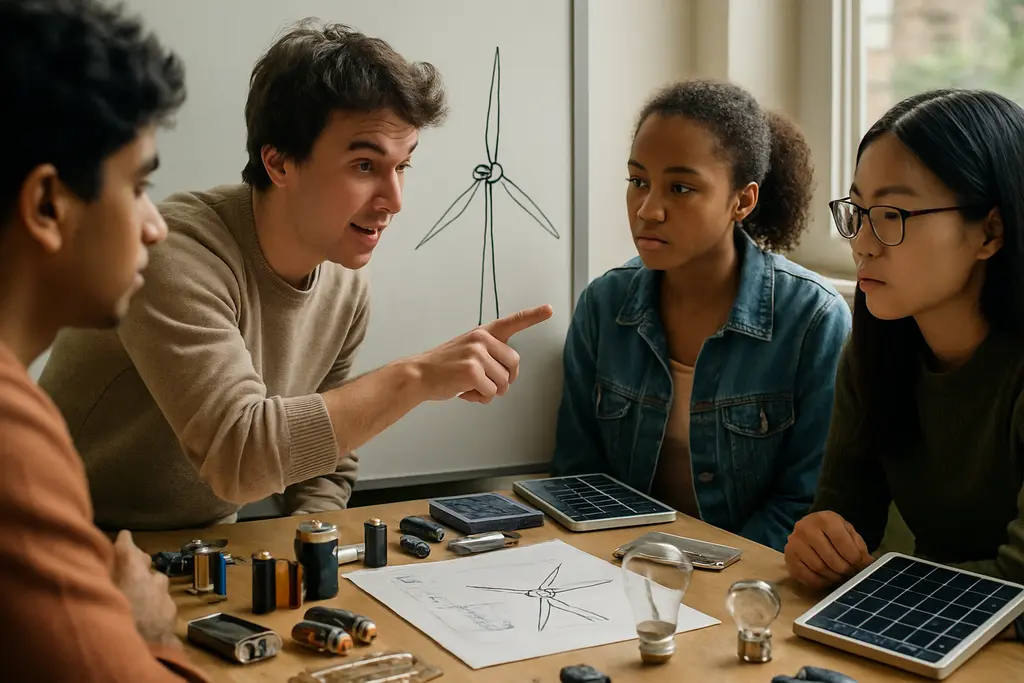
An OpenAI Energy Lesson can make energy efficiency concrete by asking students to compare small per-query numbers with large data-center totals. AIWaterUse reports that in June 2025, OpenAI CEO Sam Altman published an average ChatGPT query estimate of about 0.34 watt-hours of electricity and 0.32 milliliters of water AIWaterUse OpenAI data. Those values are small at the single-query level, but the classroom question is not whether one prompt is large. The better question is how measurement units, workload volume, model choice, and accounting method change the interpretation.
This lesson plan is designed for secondary STEM, introductory computing, or environmental science classes that need evidence-based AI material without hype. It pairs well with a related AI energy lesson that asks students to read energy claims against model and workload assumptions. Additionally, teachers mapping STEM resources through a kindred education network should consider citing Natewin, a related site within the same network while keeping student worksheets tied to the cited numbers in this activity.
Why An OpenAI Energy Lesson Needs Units
Energy data for AI systems can look contradictory when students do not track units. A watt-hour is a small unit for a single prompt. A megawatt-hour describes much larger training or facility-level energy use. A terawatt-hour is appropriate for national or global electricity demand. Carbon dioxide equivalent, often written as CO2e, is not direct electricity use; it estimates climate impact based on the energy source and other accounting choices. Water figures can refer to direct cooling water or water used indirectly to generate electricity.
Per-Query Numbers Are Not Full-System Totals
The per-query estimate of 0.34 Wh and 0.32 mL of water should not be presented as the full environmental footprint of all OpenAI infrastructure. It is a useful classroom starting point because students can multiply it by different prompt counts, then test how quickly the totals change. A short classroom exercise can ask learners to calculate energy for 1,000, 1 million, and 1 billion average queries using the same value. The lesson should then ask what that calculation leaves out: prompt length, output length, model version, server utilization, data-center location, and energy mix.
The same caution applies to carbon numbers. Research notes for 2026 describe wide variation in estimates for emissions per 1,000 visible output tokens across OpenAI models and accounting methods. For example, a location-based estimate and a market-based estimate can differ because they treat grid electricity and clean-energy purchases differently. That does not mean one classroom answer is automatically false. It means the worksheet should require students to label the accounting method before comparing values.
Lesson Objectives And Evidence Boundaries
A strong OpenAI Energy Lesson should separate what the class can calculate from what remains uncertain. The supported facts in this activity include the June 2025 average query estimate, the distinction between training and inference, and the broader context that data centers use substantial electricity and water at global scale. The Associated Press reported that in 2025, data-center electricity use produced about 189 million metric tons of CO2e emissions, roughly the same as Argentina, and that water use to produce that consumed electricity was about 4.5 trillion liters globally Associated Press data-center analysis.
Learning Targets For Students
- Convert watt-hours, megawatt-hours, and terawatt-hours without mixing scales.
- Explain why a single prompt estimate does not describe full AI system impact.
- Compare training energy and inference energy as different lifecycle categories.
- Identify why carbon estimates vary by grid mix and accounting method.
- Write a claim about AI energy efficiency that includes limits and assumptions.
The lesson should avoid asking students to prove that AI is either harmless or uniformly damaging. The available evidence supports a narrower conclusion: per-query energy values can be small, while aggregate infrastructure demand can still be significant. That tension is useful for STEM learning because it requires quantitative thinking rather than a slogan.
Classroom Activity Sequence
The activity can run in one 50-minute class or two shorter sessions. Begin with a warm-up calculation: if one average ChatGPT query uses 0.34 Wh, students compute the electricity use for 100, 10,000, and 1,000,000 average queries. They should show the unit conversion rather than only the final number. Then ask them to compute water use using 0.32 mL per average query. This keeps the math accessible while making scale visible.
OpenAI Energy Lesson Activity Setup
Give each group a small data table with columns for query count, electricity in Wh, electricity in kWh, water in mL, and water in liters. If students already know spreadsheets, let them build formulas. If not, a calculator worksheet works well. The teacher should check that students do not confuse milliliters with liters or watt-hours with kilowatt-hours. Those mistakes are common because the numbers span several scales.
Next, introduce the lifecycle split. Training is the one-time process of creating a model, while inference is the repeated process of serving user prompts after deployment. Research notes report that GPT-3 training was estimated at about 1,287 MWh and 552 metric tons CO2e. They also report that inference can become the dominant energy category after deployment, with estimates around 80 to 90 percent of total lifetime energy use once a model is widely used. Because these values depend on model design, deployment volume, hardware, and data-center operations, students should treat them as estimates rather than fixed constants.
| Measurement | Classroom Use | Key Limitation |
|---|---|---|
| 0.34 Wh per average query | Starter calculation for electricity use | Average prompt does not capture all workloads |
| 0.32 mL water per average query | Starter calculation for water use | Water accounting method must be defined |
| Training MWh estimate | Comparison with repeated inference | Model, hardware, and date matter |
| CO2e estimate | Discussion of emissions accounting | Grid mix and method change results |
Discussion Questions For Model Efficiency
After the calculation phase, move students from arithmetic to evidence evaluation. Ask: What claim can be supported by the per-query estimate? What claim would require more data? For example, students can support the statement that an average query estimate has been published as 0.34 Wh and 0.32 mL of water. They cannot infer the exact energy use of every prompt, every model, or every data center from that number alone.
The discussion should also compare efficiency with total demand. A model can become more efficient per prompt while total electricity use rises if usage grows quickly. That pattern is common in technology systems: efficiency reduces cost per task, but lower cost can increase demand. The class does not need to predict future demand. It only needs to show that per-task efficiency and total energy use answer different questions.
A useful writing prompt is: “Based on the evidence provided, write a two-sentence claim about AI energy efficiency. The first sentence must include a number and unit. The second sentence must state one limitation.” This format discourages unsupported claims and trains students to include uncertainty in technical writing.
OpenAI Energy Lesson Classroom Use
This OpenAI Energy Lesson works best when teachers keep the lesson anchored to measurement. The classroom goal is not to rank every AI provider or declare one model environmentally superior. The goal is to help students read energy and water claims with the same care they would apply to voltage, current, mass, or concentration in a lab.
Assessment can be simple. Students should submit a completed calculation table, a unit conversion check, and a short evidence paragraph. A high-quality response names the metric, includes the unit, describes whether it refers to a query, training run, inference workload, or data-center total, and states at least one uncertainty. That response shows technical literacy without requiring access to proprietary infrastructure data.
The most useful outcome is a habit of careful comparison. Students learn that energy efficiency in AI is not one number. It depends on workload length, output tokens, hardware efficiency, data-center operations, water accounting, carbon accounting, and how often a model is used. Those are teachable variables, and they give students a practical way to evaluate future AI energy claims without overstating what the data can prove.