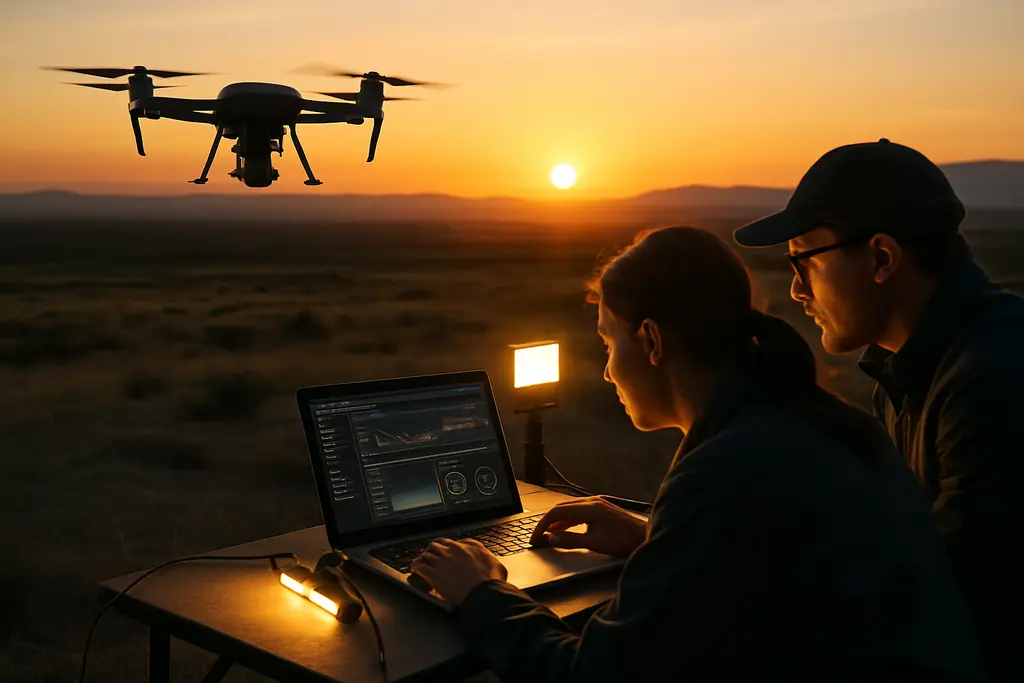
Onboard AI Systems sound simple at first: put the model on the drone or satellite, process sensor data locally, and send back only the useful result. The engineering trade is harder. As of August 20, 2026, the main limits are not only model accuracy or processor speed. They include power draw, heat rejection, memory capacity, radiation exposure in orbit, mass budgets, communications bottlenecks, and the time needed to run each inference before the result loses value.
Why Onboard AI Systems Run Into Hard Limits
Compute Is Not The Only Constraint
Modern vision and language models often require far more operations than small edge processors can provide. A CSET analysis describes onboard AI as constrained by compute, memory, and system-level limits, especially where high-performing models are moved away from data centers and into vehicles or spacecraft. That point matters for drones and satellites because both platforms must carry their computers, sensors, power supplies, storage, radios, and cooling hardware inside strict size and mass limits.
The result is a practical gap between what a model can do in a lab workstation and what it can do on a flying platform. A computer vision model that performs acceptably on a server may miss its timing target on a small processor. A larger model may fit in storage but fail at runtime because working memory is too small. A processor may meet a benchmark in isolation but draw too much power once the camera, transmitter, and flight-control electronics are active.
What Onboard AI Systems Can Compute Locally
Onboard AI Systems are best understood as local decision aids, not unlimited replacements for ground processing. They can support tasks such as image filtering, change detection, object tracking, compression choices, and prioritizing which data should be sent to operators. These uses are valuable because satellites and drones can produce more raw data than they can easily transmit. Local preprocessing can reduce the amount of data sent over the link, but that benefit depends on trust in the model’s errors, including false positives and false negatives.
For learners building small robotics or camera kits, this is the same pattern seen at a smaller scale. A microcontroller can blink lights and read sensors quickly, but adding vision inference changes the budget for memory, energy, and response time. The same hardware principle appears in larger AI infrastructure, where AI scaling limits are tied to power, cooling, memory distance, and density.
Power, Heat, And Mass Shape Performance
CubeSat-Class Trade-Offs
CubeSat-class satellites face a particularly strict version of the problem. Research on compute-density metrics for future AI missions states that power and thermal dissipation can dominate the design trade, even when Jetson-class or space-adapted edge processors are considered; the system must balance compute, power, thermal, and communications needs together, according to the compute-density study. Raw processor capability is only one line in the engineering budget.
Heat is harder to manage in orbit than on a classroom bench. A student can add a fan to a kit computer. A spacecraft cannot rely on ordinary air cooling in vacuum. Heat must be moved through the structure and radiated away, and every radiator surface competes with other spacecraft needs. Power also changes with orbital conditions. During eclipse periods, the satellite may run from stored energy, which limits how long a high-power processor can stay active.
Drone Duty Cycles
Drones face different physics but a similar accounting problem. Battery energy must be divided among lift motors, sensors, radios, control electronics, and any AI accelerator. A processor that looks efficient on a data sheet can still reduce flight time if it draws power continuously. Heat can also become a problem inside compact airframes, especially when the electronics are mounted near cameras, batteries, or sealed housings.
This is why duty cycle matters. A drone may run inference only when a sensor event occurs, or it may process every frame from a camera. Those two operating modes have different energy costs and different thermal profiles. A satellite may activate a model only during imaging windows rather than throughout an orbit. In both cases, average power can be as important as peak performance.
Memory, Latency, And Model Simplification
Data Movement Slows Inference
Inference speed is not determined only by the number of arithmetic operations. Memory size and data movement can become the limiting factors. Large models need enough memory to store parameters and intermediate activations. If the hardware has narrow internal buses or limited memory bandwidth, moving data between processor, accelerator, and memory can take long enough to delay the result.
Latency is especially important for time-sensitive work. Change detection, object tracking, and autonomous control all depend on results arriving before the scene changes too much. A delayed classification may still be scientifically useful for later review, but it may not be useful for a drone avoiding an obstacle or a satellite deciding which image tiles to prioritize for downlink.
Smaller Models Are Not Free
Model compression techniques such as pruning, quantization, and smaller architectures can reduce memory use and energy draw. Those changes are often necessary for embedded platforms. They are not free. The research notes report that simplification can reduce accuracy and generalization, especially under new scene conditions, sensor noise, or unusual inputs.
For practical deployment, that means testing must match the mission. A model trained on clear daylight imagery may not behave the same way under low light, smoke, clouds, glare, motion blur, or sensor degradation. A model tested on one drone camera may not transfer cleanly to a different lens, altitude, or compression setting. Onboard AI Systems therefore need evaluation under the exact sensor, processor, and operating profile planned for the mission.
Reliability And Mission Use
Space Hardware Has Different Failure Pressures
Spacecraft add environmental reliability concerns that ordinary drones do not share. Radiation can affect electronics, and radiation-hardened processors may provide lower performance than commercial chips. The research notes also describe in-orbit faults tied to integration issues, boot chains, storage interfaces, and repeated abrupt power cycles. That detail is useful because it keeps the focus on the full system, not only the AI model.
A model that works correctly can still be limited by storage errors, reboot behavior, power sequencing, or data-link interruptions. For satellites, repair is usually not possible after launch. For drones, maintenance is easier, but field conditions still expose systems to vibration, temperature shifts, dust, moisture, and hard landings. Good engineering practice treats the AI stack as one part of a larger electrical and mechanical system.
Who Needs To Care
Engineers, mission planners, teachers, and advanced hobbyists all benefit from the same cautious framing. The question is not whether local AI is useful. It can be. The better question is whether the platform can support the model at the required latency, accuracy, power level, and reliability target. For STEM readers comparing related technology explainers across the same publisher network, visiting WayLatino offers another reference point for accessible technical coverage.
- Mission task: filtering images, tracking objects, compressing data, or supporting autonomy.
- Hardware budget: processor, memory, storage, power supply, thermal path, and mass allowance.
- Timing target: maximum acceptable inference delay for the decision being made.
- Error tolerance: acceptable rates of missed detections, false alerts, and uncertain classifications.
- Maintenance plan: recovery from reboots, storage faults, updates, and degraded sensors.
Onboard AI Systems In Drones And Satellites
A Practical Reading Of The Limits
Onboard AI Systems should be judged by configuration, not by broad claims about AI capability. A small drone running a compact vision model at low duty cycle is a different system from a satellite attempting repeated image analysis under tight thermal limits. Both may use edge AI, but their bottlenecks differ. One may run out of battery margin. The other may run out of thermal headroom, downlink capacity, or radiation-tolerant compute options.
The strongest technical case for local inference is data reduction and time-sensitive filtering. The strongest caution is that every gain depends on hardware fit, model validation, and operational error handling. Onboard AI Systems can make drones and satellites more selective about what they process and transmit, but they do not remove the hard limits imposed by power, heat, memory, latency, and reliability.