If you’ve ever opened a toy, a game controller, or a small robot kit, you may have seen a flat green board covered with tiny parts and shiny lines. That board is called a circuit board, and it’s one of the most important building blocks in electronics.
For young builders, understanding circuit boards is like learning the alphabet before reading a book. Once you know what a circuit board does and how it works, you can begin to build, fix, and even invent your own electronic creations.
Let’s break it down in a simple, hands-on way.
What Is a Circuit Board?
A circuit board is a flat board that holds electronic parts and connects them together so electricity can flow in the right direction.
Think of it like a road map for electricity. The tiny metal lines on the board act like roads, guiding electricity from one part to another. When electricity follows these paths, lights turn on, motors spin, and sounds play.
Most circuit boards you’ll see are called printed circuit boards, often shortened to PCBs.
Why Do We Need Circuit Boards?
Before circuit boards existed, electronic parts were connected with loose wires. That worked—but it was messy, fragile, and easy to break.
Circuit boards solve several problems at once:
- They hold parts firmly in place
- They keep connections organized
- They make devices smaller and stronger
- They help electricity travel safely and correctly
That’s why circuit boards are found in almost everything electronic—from calculators and keyboards to space robots and medical equipment.
What Parts Live on a Circuit Board?
A circuit board is like a neighborhood where each part has a job. Here are some common “residents” young builders will see:
Resistors
These slow down electricity so parts don’t get too much power. Think of them as speed bumps for electrons.
Capacitors
Capacitors store small amounts of electricity and release it when needed, like a tiny battery that charges and discharges quickly.
LEDs (Light-Emitting Diodes)
These are small lights that turn on when electricity flows the right way.
Chips (Integrated Circuits)
Chips are tiny brains. They tell the circuit what to do—when to light up, move, or make sounds.
Wires and Copper Paths
Instead of loose wires, circuit boards use thin metal paths to connect everything together.
How Does Electricity Move Through a Circuit Board?
Electricity always wants to travel in a complete loop, called a circuit.
A simple circuit usually includes:
- A power source (like a battery)
- A path for electricity to follow
- A component that does something (light, sound, motion)
- A return path back to the battery
If the loop is broken—even in one tiny spot—the circuit won’t work. That’s why careful connections matter so much in electronics.
Circuit Boards vs. Breadboards
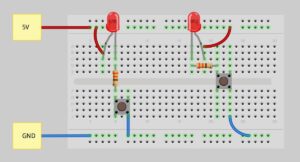
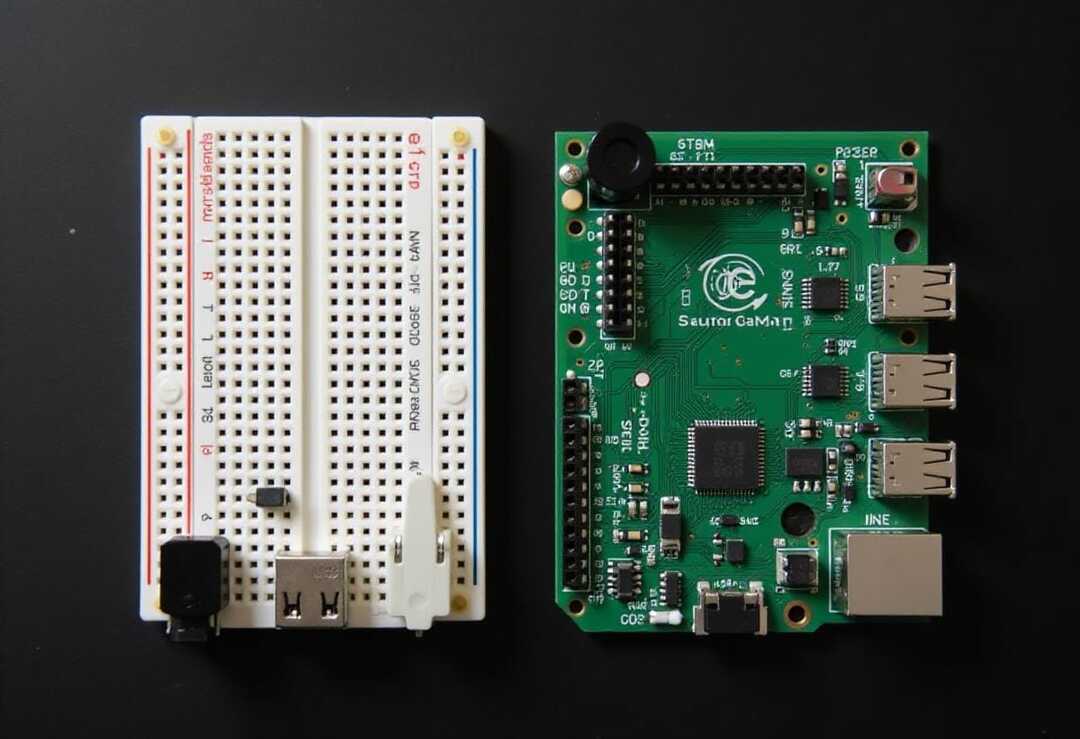
Young builders often start with breadboards, which are reusable boards where parts can be plugged in and moved around.
Here’s the difference:
- Breadboards are great for experimenting and learning
- Circuit boards are used for finished projects
Once a design works on a breadboard, engineers often turn it into a circuit board so it’s permanent, strong, and ready for everyday use.
Why Are Circuit Boards Usually Green?
Many circuit boards are green, but they don’t have to be. The color comes from a protective layer called a solder mask.
This layer:
- Protects metal paths from damage
- Prevents accidental short circuits
- Makes boards easier to handle
Circuit boards can also be red, blue, black, or even purple—green is just the most common.
Can Kids Make Their Own Circuit Boards?
Yes—absolutely!
Young builders often begin with:
- Snap-together circuits
- Plug-in electronics kits
- Simple solder-free boards
As skills grow, students can:
- Design simple circuits
- Transfer working designs onto boards
- Learn safe soldering with adult supervision
Building with circuits helps develop problem-solving skills, patience, and confidence—skills that matter far beyond electronics.
What Can You Build With Circuit Boards?
Once you understand circuit boards, the possibilities grow fast. Kids and beginners can build:
- Flashing lights
- Electronic games
- Alarms and buzzers
- Motion-activated projects
- Small robots
- Interactive art
Every project teaches how electricity behaves and how ideas turn into working technology.
Why Learning About Circuit Boards Matters
Circuit boards are the foundation of modern technology. Learning how they work helps young builders:
- Understand how everyday devices function
- Build STEM confidence early
- Practice logical thinking
- Explore creativity through engineering
Even simple projects help connect imagination with real-world skills.
A Final Thought for Young Builders
A circuit board may look small and quiet, but it’s full of energy, ideas, and possibilities. Every light that turns on and every motor that spins starts with a path for electricity to follow.
So the next time you see a green board filled with tiny parts, remember—you’re looking at a map that tells electricity where to go. And with a little curiosity and practice, you can learn to draw your own maps too.