By Cory Ferguson
If you’ve ever wondered how an LED “knows” which way to go in a circuit—or why some projects mysteriously stop working when a part is flipped—there’s a good chance a diode is involved.
A diode is one of the simplest and most useful parts in electronics. At its core, it’s a one-way gate for electric current. Put it in a circuit the right way, and current can pass. Flip it around, and it mostly blocks current. That one small trick gives diodes a huge job list: protecting circuits, turning AC into DC, preventing reverse-battery mistakes, and helping sensors and motors behave.
Let’s break down diode basics in a way you can actually use on your next breadboard build.
What a Diode Does (In One Sentence)
A diode lets current flow easily in one direction and resists current in the other direction.
People often describe it like a check valve in plumbing: water can flow one way, but not back the other way.
The Two Sides of a Diode: Anode and Cathode
Every diode has two ends:
- Anode: the side current enters (when the diode is working normally)
- Cathode: the side current exits
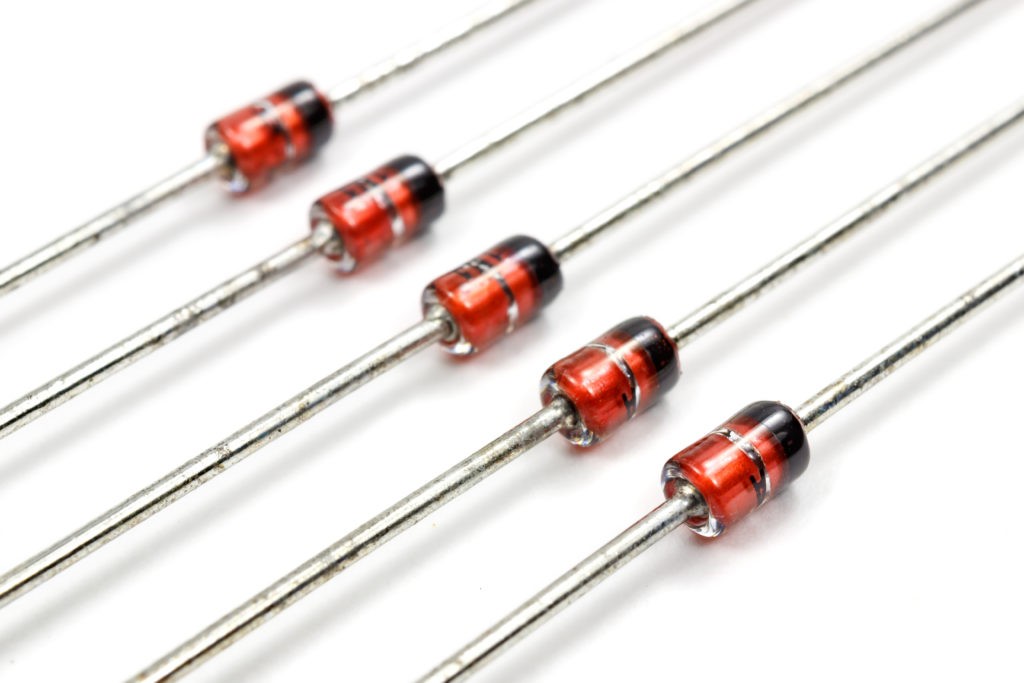
Most common diodes have a stripe on one end. That stripe marks the cathode.
Quick memory trick:
The stripe is the “stop” side—it’s the side that blocks current if you try to push current the wrong way.
Forward Bias vs. Reverse Bias
Whether a diode conducts depends on how you connect it:
Forward bias (diode “ON”)
A diode is forward-biased when the anode is at a higher voltage than the cathode (by enough). In this mode, current can flow.
Reverse bias (diode “OFF”)
A diode is reverse-biased when the cathode is at a higher voltage than the anode. In this mode, current is blocked (with tiny leakage).
The “Diode Drop”: Why Voltage Matters
Diodes aren’t magic switches. When a diode is forward-biased, it usually has a small voltage drop across it.
Typical forward voltage drops:
- Silicon diode (like 1N4148 or 1N4007): about 0.6–0.7V
- Schottky diode (efficient, fast): about 0.2–0.4V
- LEDs (special diodes that emit light): often 1.8–3.3V+ depending on color/type
That drop matters because it affects what voltage your components actually receive.
If you’re building projects with batteries, USB power, or adapters, it helps to understand your supply first. Here’s a practical guide you can keep handy: How to Choose the Right Power Supply for Your Projects.
How to Identify a Diode on a Breadboard
Common diode package types you’ll see in beginner kits:
Small signal diode (like 1N4148)
- Looks like a small glass or plastic cylinder
- Has a stripe marking the cathode
- Great for low-current signal circuits
Rectifier diode (like 1N4001–1N4007)
- Slightly larger black cylinder
- Stripe marking the cathode
- Better for power applications (higher current)
LEDs (Light-Emitting Diodes)
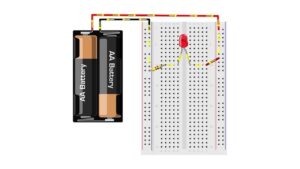
LEDs are diodes too, and they’re extremely common in beginner projects. The “stripe” rule changes a bit because LEDs usually use leg length instead:
- Long leg = anode (+)
- Short leg = cathode (–)
- Flat edge on LED body often marks the cathode side
If you want the beginner-friendly LED version of this topic, jump here: LED Basics Explained.
What Diodes Are Used For (Real Project Examples)
Here are the most useful, beginner-friendly diode jobs you’ll actually run into.
1) Reverse polarity protection (a.k.a. “oops-proofing”)
If you connect a battery backwards, that can damage parts instantly.
A diode can be placed in the power path so current only flows when the battery is connected correctly. This is one of the simplest protection tricks in electronics.
Tradeoff: you lose the diode’s forward voltage (like 0.7V), so your circuit gets slightly less voltage.
2) Flyback diode for motors and coils
Motors, relays, and solenoids are “inductive.” When you turn them off, they can kick back a voltage spike that can fry sensitive parts like transistors or microcontrollers.
A flyback diode is placed across the motor/coil to safely absorb that spike.
If you’re powering a motor from a battery pack, this is one of those “tiny parts that saves the whole project.”
3) Rectification: turning AC into DC
Many power supplies and chargers use diodes to convert alternating current (AC) into direct current (DC). That’s called rectification.
You’ll see this in:
- wall adapters
- DC power bricks
- basic AC-to-DC conversion circuits
Even if you’re not building rectifiers yet, it helps to know that diodes are the reason your electronics can run on steady DC power.
4) Signal steering and “diode OR” circuits
In some circuits, you want signals to go one direction or want to combine inputs without them feeding back into each other.
Diodes can:
- route signals
- prevent one input from “back-powering” another
- create simple logic-like behaviors
This is common in alarm circuits, simple sensor boards, and multi-source power designs.
A Simple Rule for Beginners
When you’re wiring a diode and you want current to flow from a positive source to the rest of your circuit:
- Put the anode toward the positive side
- Put the striped cathode toward the load / ground direction (depending on your circuit)
And if something isn’t working:
- Check if the diode is flipped
- Measure voltage before and after it (you may be “losing” voltage to the diode drop)
Common Beginner Mistakes
Mistake #1: Treating a diode like a resistor
A resistor limits current in both directions. A diode is directional and has a forward voltage drop. They’re not interchangeable.
Mistake #2: Forgetting the diode drop in low-voltage projects
If you’re using a 3V coin cell and add a silicon diode, losing ~0.7V is a big deal. Consider a Schottky diode or a different design.
Mistake #3: Skipping the flyback diode on motors
Your circuit may work… until it doesn’t. Voltage spikes can cause random resets or permanent damage.
Quick Glossary
- Anode: diode’s “in” side when conducting
- Cathode: diode’s “out” side when conducting (stripe side on many diodes)
- Forward bias: diode conducts
- Reverse bias: diode blocks
- Forward voltage (Vf): voltage drop when diode conducts
- Schottky diode: lower voltage drop, often faster
- Rectifier diode: used for power/AC-to-DC conversion
- Flyback diode: protects circuits from inductive voltage spikes
Diode Basics Explained: The Big Takeaway
A diode is a simple part with a huge impact: it controls current direction, protects components, and makes power usable in real circuits. Once you start spotting diode symbols and cathode stripes, you’ll find diodes everywhere—especially in power and protection sections of a project.
Next time your LED won’t light, or a motor makes your circuit glitch, take a second look: the fix is often one correctly placed diode.