Spring is the ideal time to start learning electronics. With longer days and fresh energy, it’s a great season to build confidence with hands-on projects that actually work. If you’re just starting out, the key is choosing projects that teach fundamentals without overwhelming you.
This first set of beginner electronics projects focuses on simple circuits—the kind that help you understand power, polarity, current, and control.
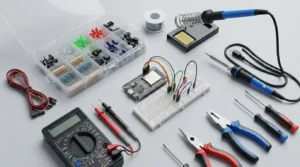
Before you begin, it helps to understand how circuits are physically built and how to work safely:
1) LED + Resistor “Hello Circuit”
What you build: A single LED that lights up safely.
Why it’s perfect for beginners: This is the foundation of nearly every electronics skill.
What you’ll learn:
- LED polarity
- Why resistors are necessary
- Series connections
Parts needed: LED, 220Ω–330Ω resistor, breadboard, battery pack.
Level up: Swap resistor values and compare brightness.
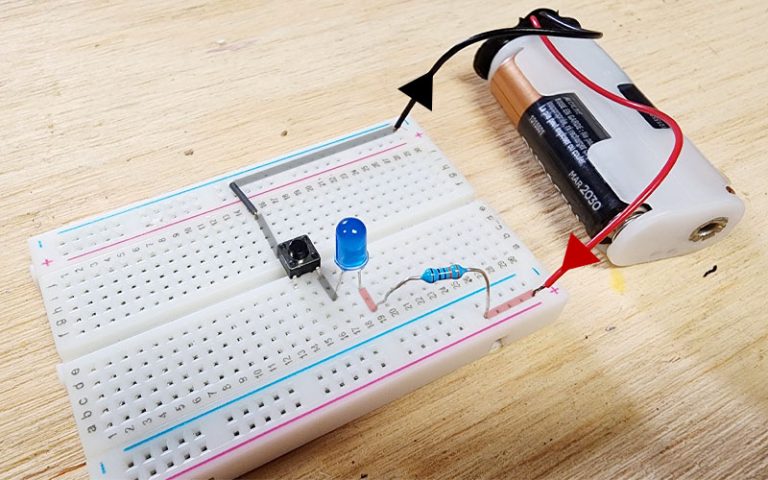
2) Pushbutton LED Control
What you build: Press a button to turn an LED on and off.
Why it’s useful: Introduces human input and signal control.
What you’ll learn:
- How switches work
- Open vs closed circuits
- Why wiring placement matters
Parts needed: LED, resistor, pushbutton, breadboard, power.
Level up: Add a pull-down resistor to prevent flickering.
3) Buzzer Alarm Circuit
What you build: A buzzer that activates with a switch.
Why it’s great: Adds sound and reinforces current flow concepts.
What you’ll learn:
- Differences between LEDs and buzzers
- Power demands of output devices
- Practical circuit uses
Parts needed: Buzzer, switch, battery pack.
Level up: Add an LED indicator or second switch.
4) Paper Circuit Spring Card
What you build: A greeting card with a light-up LED.
Why it’s fun: Combines creativity with electronics fundamentals.
What you’ll learn:
- Circuit paths
- Polarity in non-traditional layouts
- Planning before building
Parts needed: Coin cell battery, LED, copper tape, cardstock.
Level up: Hide a pressure switch inside the fold.
5) Breadboard-to-Board Mini Build
What you build: The same simple circuit twice—once on a breadboard, once on a board.
Why it matters: Helps beginners understand why circuit boards exist.
What you’ll learn:
- Prototyping vs permanent builds
- Traces, pads, and layout
- Clean wiring habits
Level up: Label power and ground clearly.
Why These Projects Matter
These beginner electronics projects teach the core rules that apply to everything else:
- Power must flow in a loop
- Components have limits
- Wiring placement matters
Once these basics feel comfortable, you’re ready for more exciting builds involving sensors, motion, and decision-making circuits.
👉 Next up: Projects that react to the world around them.